My Store
WANALIT 36 Eggs Incubators for Hatching Eggs,Egg Incubator with 4 Incubate Mode for Hatching Duck Goose Quail, Automatic Egg Turning Humidity Monitoring,Poultry Chicken Incubator with Egg Candle
WANALIT 36 Eggs Incubators for Hatching Eggs,Egg Incubator with 4 Incubate Mode for Hatching Duck Goose Quail, Automatic Egg Turning Humidity Monitoring,Poultry Chicken Incubator with Egg Candle
Couldn't load pickup availability
Every spring, The kids of course love the process of hatching, for the candling and watching the embryos develop and because well, baby chicks. Hatching chicken eggs or your own chicks allows you to have more control over the breeding process, and you can choose the specific breeds you want.You can choose from purebreds, Easter Eggers, blue egg laying breeds, olive eggers and unique breeding projects that a certain farm may be offering, such as Moss Eggers, Heavy Bloom layers or interesting hybrids like Bright Layer Easter Eggers.
WANALIT incubator is ready to be filled with 36 fertile eggs and begin incubating immediately.An included direction booklet will walk you through the initial steps, explain the digital display and instruct you on how to customize the settings. Day by day, we’ll witness the miraculous journey of a tiny heart beating, delicate blood vessels forming, and the rapid filling of the egg as we near hatch day. It’s an incredible process that reminds us of the delicate, yet remarkable resilience of life itself.
Specification:
Color:White
Package included:
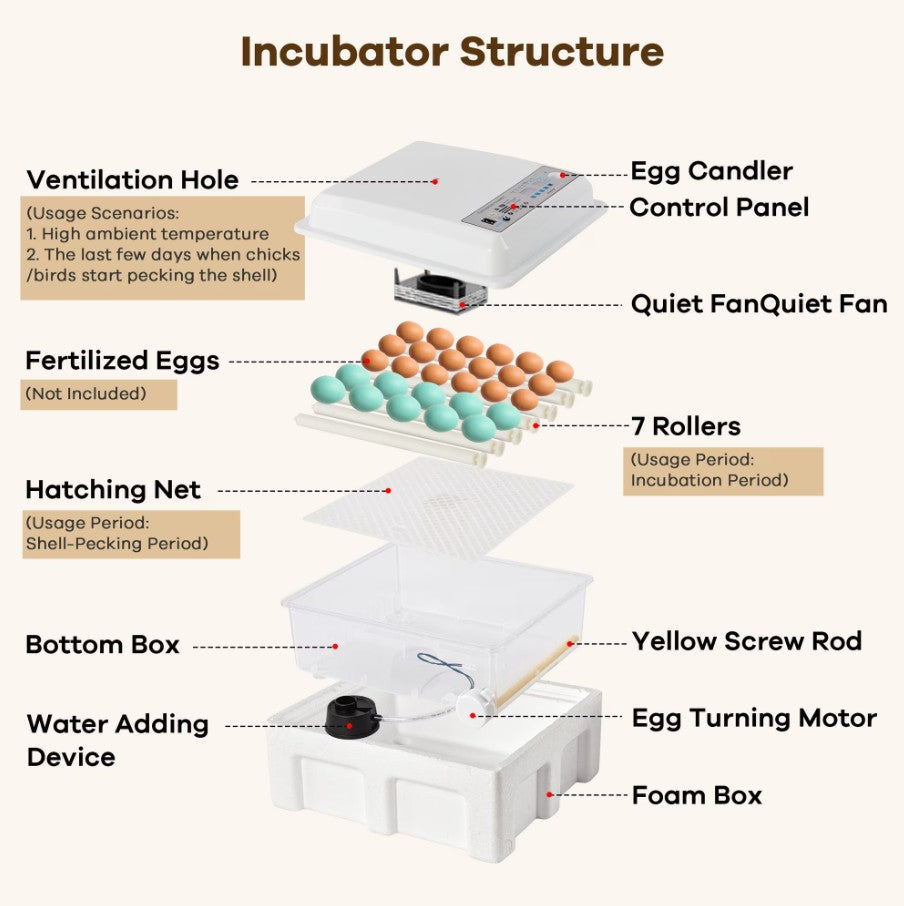
A transparent water pipe + Automatic water supply base*1
Water bottle with long tip + Spray bottle*1
12V Battery connection cable *1
220V/110V Power Cables *1
Hatching net *1
Roller *7
Thermal insulation foam box *1
Water feeder *1
Feeder *1
-
Versatile Poultry Egg Incubator: This premium egg incubator featuring 7 adjustable rollers, accommodating various egg sizes including chicken, quail, duck, and goose. Its customizable design ensures perfect positioning for all poultry eggs – excellence for home, farm, or classroom use
-
Smart Automation System: This advanced incubator for chicken eggs offers 4 preset modes (chicken/duck/goose/pigeon) with automatic temperature calibration throughout incubation cycles. it maintains precise thermal stability without manual adjustments – your hassle-free egg hatching. In automatic incubation mode, you cannot manually set the temperature of the incubator
-
Constant & Suitable Temperature: The quail egg incubator adopts highly efficient heating elements, which can heat up to the set value in a short time, which helps to maintain a stable temperature
-
Auto-Turning & Humidity Control: Maximize hatch rates with dual automation: Eggs rotate every 90 minutes via motorized turning (mimicking natural hen behavior), while the humidity-regulated incubator self-replenishes water(Please prepare water bottle by yourself). This egg incubator with automatic egg turning and humidity control prevents embryo adhesion and dehydration
-
Uninterrupted Operation & Monitoring: Dual 110V/12V Power clamp wire compatibility ensures continuous operation. Features built-in egg candler for real-time embryo development tracking – promptly remove unfertilized eggs. Perfect chicken incubator for farms and labs
-
Why Incubate Eggs At Home?
STUDY: Incubating eggs at home is a great learning experience for children. The process of watching the embryo grow into baby chicks is amazing. It also teaches children to respect nature and appreciate all living things.
CONTROL: Hatching chicken eggs or your own chicks allows you to have more control over the breeding process, and you can choose the specific breeds you want.
BREEDS: You can order your eggs online or from local breeders to get specific breeds you want to try and incubate them.
COST: Hatching your own chickens can be more cost-effective than purchasing adult birds, especially if you are able to source eggs locally.
SUSTAINABLE: Finally, hatching your own chicks can be a sustainable and humane way to raise poultry, as you can ensure that the birds are raised in a safe and healthy environment by giving them a good, healthy start with the proper care and vitamins in their first days of life.
-
What To Look For In A Good Hatching Egg?
Shape– Make sure the egg you want to hatch has a good shape. Eggs that have an odd shape have a lower chance of hatching. This can be due to genetic abnormalities in the yolk, or just an inability of the chick to get out of the egg.
Size– Choose hatching eggs that are an appropriate size for your hen. If an egg is too large it could contain a double yolk or another egg inside. These eggs won’t hatch. Also, if the egg is too small it may not have a yolk at all. Fairy eggs are just misfires in the chicken’s reproductive system.
Shell– Take a good look at the shell of your egg before using it for hatching. You want a shell that’s relatively clean, but be sure not to wash the eggs prior to hatching. You want to keep the natural flora intact. If the shell is too thin, or rippled it can also interfere with the growth of the embryo and hatching.
Age– The age of the egg can affect the hatch rate. An older egg will not have as high of a hatch rate as a fresh one. Using an egg that is less than 1 week old is ideal.
Characteristics Of The Hen– Consider the hen that laid the egg. Overall is she a healthy hen? Hens that have problems like being eggbound can pass those traits on. Also, consider the age of your hen. A very young hen or a very old hen might produce a lower-quality egg.
-
What to look for when candling eggs?
Clear eggs (ones with zero development) – remove these
Ring of blood (dead embryo) – remove these
Murkey contents that jiggle or slosh about (dead embryo) – remove these
A dark spot that is significantly smaller than the rest of the developing eggs (dead embryo) – remove these
Blood veins (alive!) – put back in the incubator
Movement (alive) – put back in the incubator
Solid mass that doesn’t slosh (alive) – put back in the incubator
Size of the air cell relative to how many days along the eggs are – adjust humidity levels based on this information. You might notice some variability between the eggs (thin and white-shelled eggs lose moisture faster than thick and dark-colored eggs), just make note of the average.
If the air cell is trending large, then increase humidity.
If the air cell is trending small, then decrease humidity.
Air cell abnormalities – sometimes the air cell can develop at the pointy end of the egg. If you notice this, then flip the egg so that it’s positioned air cell up in your egg turner.
Share